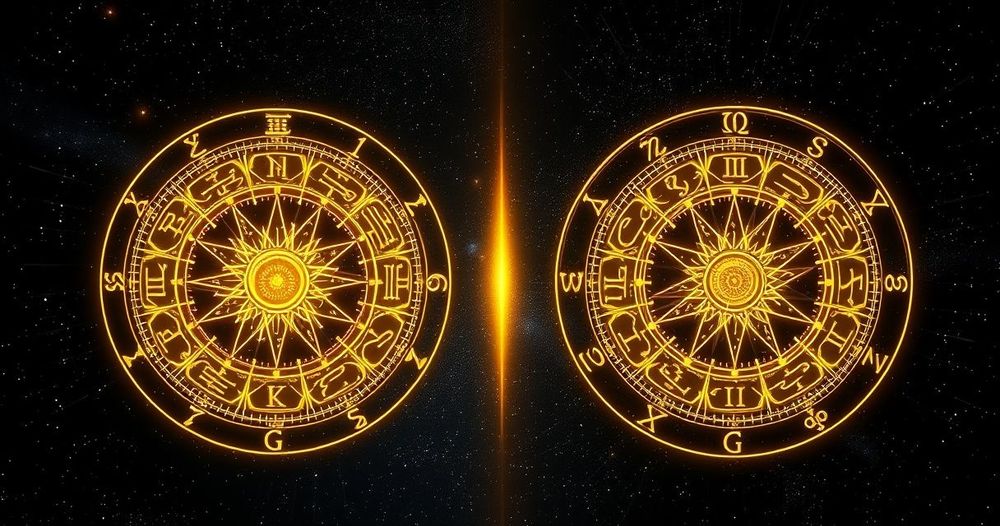
The Two Great Traditions
When people ask 'What is my sign?' they often refer to Western astrology - the system popularized in horoscope columns and apps. But there is another, older, and arguably more precise system: Vedic astrology, also known as Jyotish or Hindu astrology, which has been practiced in India for over 5,000 years.
Both systems share a common origin in Babylonian astronomy and use the same 12 zodiac signs and 7 classical planets. Yet they have diverged significantly over the centuries. Here is what sets them apart.
1. Zodiac System: Sidereal vs Tropical
This is the single biggest difference.
- Vedic (Sidereal) anchors the zodiac to fixed stars in the sky. Aries begins where the constellation Aries actually is.
- Western (Tropical) anchors the zodiac to the spring equinox (the Sun's position on March 21). Aries begins at the vernal equinox.
Due to precession of the equinoxes, a 26,000-year wobble of Earth's axis, the two zodiacs have drifted apart by approximately 24° over millennia. This means your Vedic Sun sign is typically one sign earlier than your Western Sun sign.
For example, someone born on April 5 is an Aries in Western astrology but a Pisces in Vedic. Neither is 'wrong', they measure different reference frames.
2. Primary Sign: Sun vs Moon
- Western astrology emphasizes the Sun sign, considering it the core of personality.
- Vedic astrology emphasizes the Moon sign (Rashi), considering it the mind, emotions, and inner self.
The Vedic view is that the Moon, being closer and changing signs every 2.5 days, is more responsive to daily life and karmic patterns, while the Sun represents the soul and the long-term life direction.
3. Houses: Whole-Sign vs Placidus
Most Vedic astrologers use the Whole-Sign House system: each zodiac sign IS one house. The Ascendant sign becomes the 1st house, the next sign the 2nd, and so on.
Western astrologers more commonly use the Placidus or other quadrant-based systems, where house cusps are calculated using complex trigonometry of the birth time and location. This can result in some houses spanning more than one sign.
Whole-Sign houses are simpler and align with the earliest astrological texts; Placidus offers more granular timing for some predictive techniques.
4. Number of Planets
- Vedic uses 9 grahas: Sun, Moon, Mars, Mercury, Jupiter, Venus, Saturn, Rahu, and Ketu (the lunar nodes, treated as shadow planets).
- Western uses Sun, Moon, Mercury, Venus, Mars, Jupiter, Saturn, Uranus, Neptune, Pluto.
Vedic astrology emphasizes Rahu (the north lunar node) and Ketu (south node) heavily, they represent karmic forces, illusions, and spiritual liberation. Most Vedic astrologers do not use Uranus, Neptune, and Pluto because they are not visible to the naked eye and have no place in classical scriptures.
5. Predictive Techniques
Vedic astrology has elaborate, time-tested predictive systems:
- Vimshottari Dasha: a 120-year cycle where each planet rules for a specific period, predicting major life events
- Antardasha: sub-periods within each Dasha
- Gochar (Transits): current planetary movements
- Ashtakavarga: point-based strength calculation
- Yogas: specific planet combinations that produce strong effects
Western astrology focuses more on transits, progressions, solar returns, and synastry for relationship analysis. It tends to be more psychological and symbolic; Vedic tends to be more event-oriented and predictive.
6. Marriage Compatibility
- Vedic uses Guna Milan (Ashtakoot system): an 8-fold compatibility check across 36 points covering temperament, longevity, intellect, mutual attraction, family compatibility, mental affinity, and progeny. 18+ points is acceptable; 24+ is excellent.
- Western uses synastry: comparing chart aspects (conjunctions, oppositions, trines, etc.) between two charts. More qualitative than scored.
7. Spiritual Orientation
Vedic astrology is fundamentally a dharma-shastra: a spiritual science integrated with yoga, ayurveda, and the path of self-realization. It views the chart as a karmic blueprint and prescribes remedies (mantras, gemstones, charity, fasting) to refine one's karma.
Western astrology in its modern form is more often psychological and humanistic, focused on personality, self-understanding, and personal growth rather than spiritual liberation.
8. Time Cycles
Vedic astrology operates within the framework of Yugas (cosmic ages, Satya, Treta, Dvapara, Kali) and Kalpas (4.32 billion years), giving it a vast civilizational time-scope. Western astrology generally focuses on individual lives and current generations.
Which One is 'Better'?
Neither is objectively superior, they answer different questions:
- Choose Vedic if you want detailed event-prediction, traditional remedies, marriage compatibility, and an integrated spiritual framework.
- Choose Western if you want personality insight, psychological self-understanding, and a system widely accepted in Western counseling and self-help contexts.
Many people find them complementary. Reading both can offer richer perspective.
Why AstroSamay is Vedic
AstroSamay is built on the Vedic (Sidereal) system with the Lahiri Ayanamsa: the standard correction used by the Indian government and most professional Jyotishis. We use the Swiss Ephemeris for astronomical accuracy and classical texts like Brihat Parashara Hora Shastra and Phaladeepika for interpretation rules.
If you have only ever known your Sun sign from a newspaper column, exploring your Vedic Kundli is like discovering a hidden dimension of yourself, one where your soul's history, your karmic gifts, and your dharmic path become visible in a language thousands of years old.